
Is CJdropshipping worth it in 2026?
For many dropshippers, that question comes up after the first stage of building a store. Finding products is relatively easy. The harder part is finding a fulfillment partner that can source products consistently, process orders, provide reasonable shipping options, handle problems, and keep supporting the business when order volume starts to grow.
CJdropshipping is often considered as an alternative to buying from individual marketplace sellers because it combines product sourcing, order fulfillment, logistics, warehousing, store integrations, and branding services in one system.
But that does not mean every seller has the same experience.
Search online and you will find many positive CJdropshipping reviews praising personal agents, sourcing support, and easier fulfillment. You will also find complaints about delayed packages, inventory problems, product quality, changing costs, and slow resolution of complicated cases.
Both sides matter.
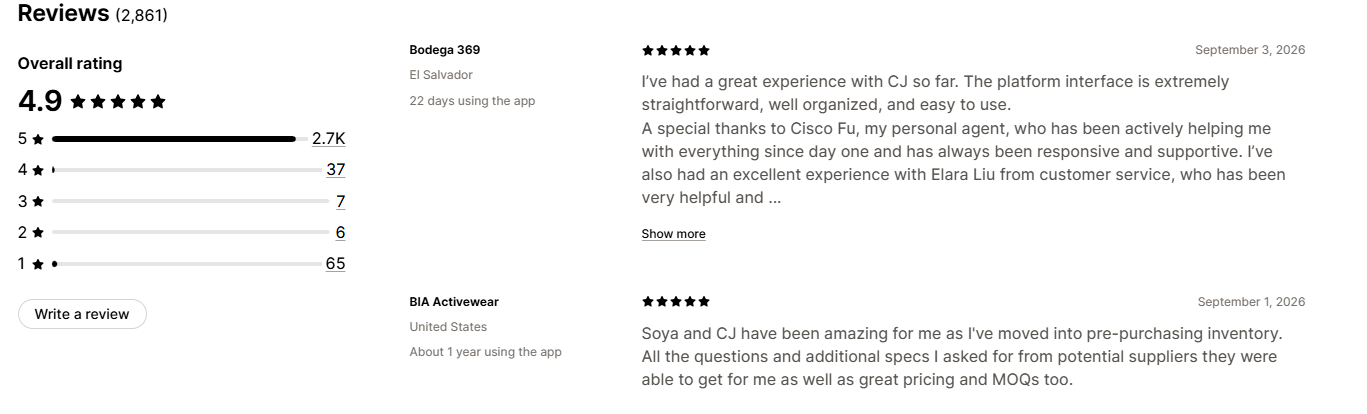
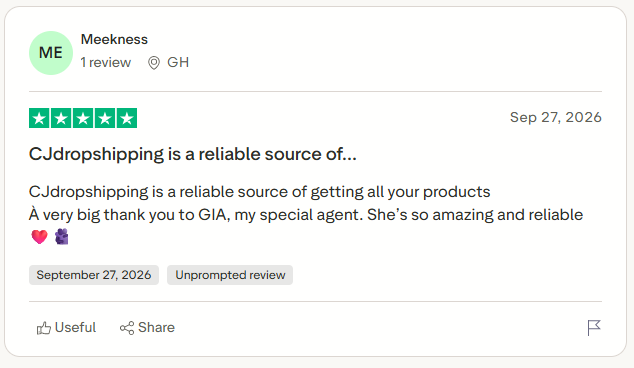
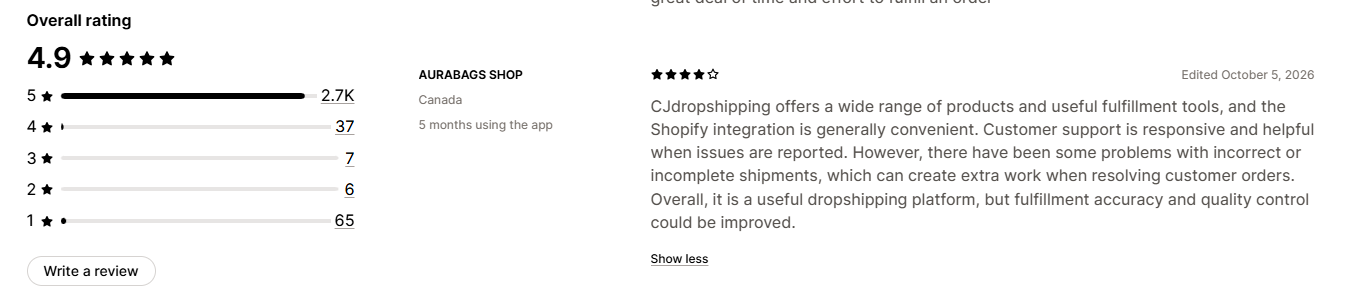
The CJdropshipping app on the Shopify App Store shows a 4.9 out of 5 rating from more than 2,800 reviews, with 96% rated five stars. At the same time, recent lower-rated reviews include complaints involving international delivery delays, warehouse issues, communication, and order resolution. Trustpilot shows a similarly strong overall distribution while also containing individual negative experiences.
That makes a simple "CJdropshipping is good" or "CJdropshipping is bad" answer far less useful than asking a better question:
What kind of seller is CJdropshipping good for, what can realistically go wrong, and can those risks be managed?
This review examines those questions in detail.
What Is CJdropshipping and How Does It Work?

CJdropshipping is a sourcing and fulfillment platform built for ecommerce sellers.
A traditional dropshipper may find a product from one supplier, arrange shipping with another logistics provider, communicate with factories separately, upload tracking manually, and later look for another company to handle custom packaging or warehousing.
CJ attempts to bring more of those steps into one workflow.
Its services include product sourcing, order fulfillment, logistics, overseas warehousing, custom packaging, print-on-demand options, store connections, and agent support.
If a seller cannot find a product already listed on CJ, they can submit a sourcing request with a product link, image, or description. CJ states that it can source products through cooperating factories and sources such as 1688, Taobao, and AliExpress. Basic sourcing is available without a separate sourcing charge, although sourcing limits can depend on the customer's account level.
A typical CJdropshipping workflow looks like this:
Find or source a product → Connect it to your store → Receive an order → Sync the order to CJ → Product processing → International or local fulfillment → Tracking → Customer delivery
For Shopify stores, for example, CJ says connected products and orders can sync into the CJ system for fulfillment. WooCommerce and other ecommerce connections are also supported through the platform.
This distinction matters.
CJdropshipping is not simply a website where you purchase a cheap product. It is closer to an ecommerce supply-chain platform.
That is also why the experience can be more complicated than ordering from a single marketplace seller.
Is CJdropshipping Worth It?
For many dropshippers, yes, CJdropshipping can be worth it, particularly if you want sourcing, fulfillment, logistics, automation, and supplier support within one ecosystem.
But it is not automatically the best choice for every seller or every product.
A useful way to think about it is this:
| Seller Situation | Is CJdropshipping Worth Considering? |
|---|---|
| Beginner testing products | Yes |
| Seller wanting to avoid large upfront inventory | Yes |
| Store selling internationally | Yes |
| Seller needing product sourcing support | Yes |
| Growing store preparing inventory | Often yes |
| Brand wanting custom packaging | Yes |
| Seller requiring guaranteed 1–2 day delivery for every order | Not necessarily |
| Business requiring highly specialized manufacturing | Depends |
| Seller wanting zero involvement in supply-chain management | Probably not |
| Business already operating its own mature factory and 3PL network | May be unnecessary |
The strongest reason to use CJ is therefore not simply "cheap products."
Its potential value comes from combining several functions:
Product sourcing + supplier coordination + fulfillment + logistics + warehousing + integrations + branding + human support
If you only compare one product price against one AliExpress listing, you may miss that larger value.
On the other hand, if your only requirement is the lowest possible unit price, CJ will not necessarily be the cheapest choice in every situation.
What Customers Usually Like About CJdropshipping
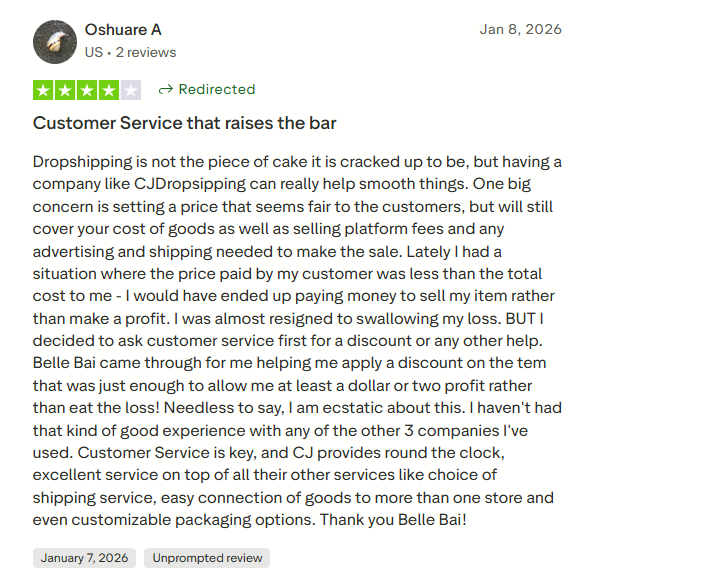
Public reviews suggest that customer support and agent assistance are among the most frequently praised parts of the CJ experience.
Recent Shopify reviews repeatedly mention agents helping sellers with sourcing, inventory, procedures, and store setup. Shopify's own AI-generated merchant summary also highlights sourcing, order management, private inventory, branding, logistics, and dedicated agent support as recurring positive themes among merchants.
But support is only one part of the experience.
1. Product Sourcing Beyond the Existing Catalog
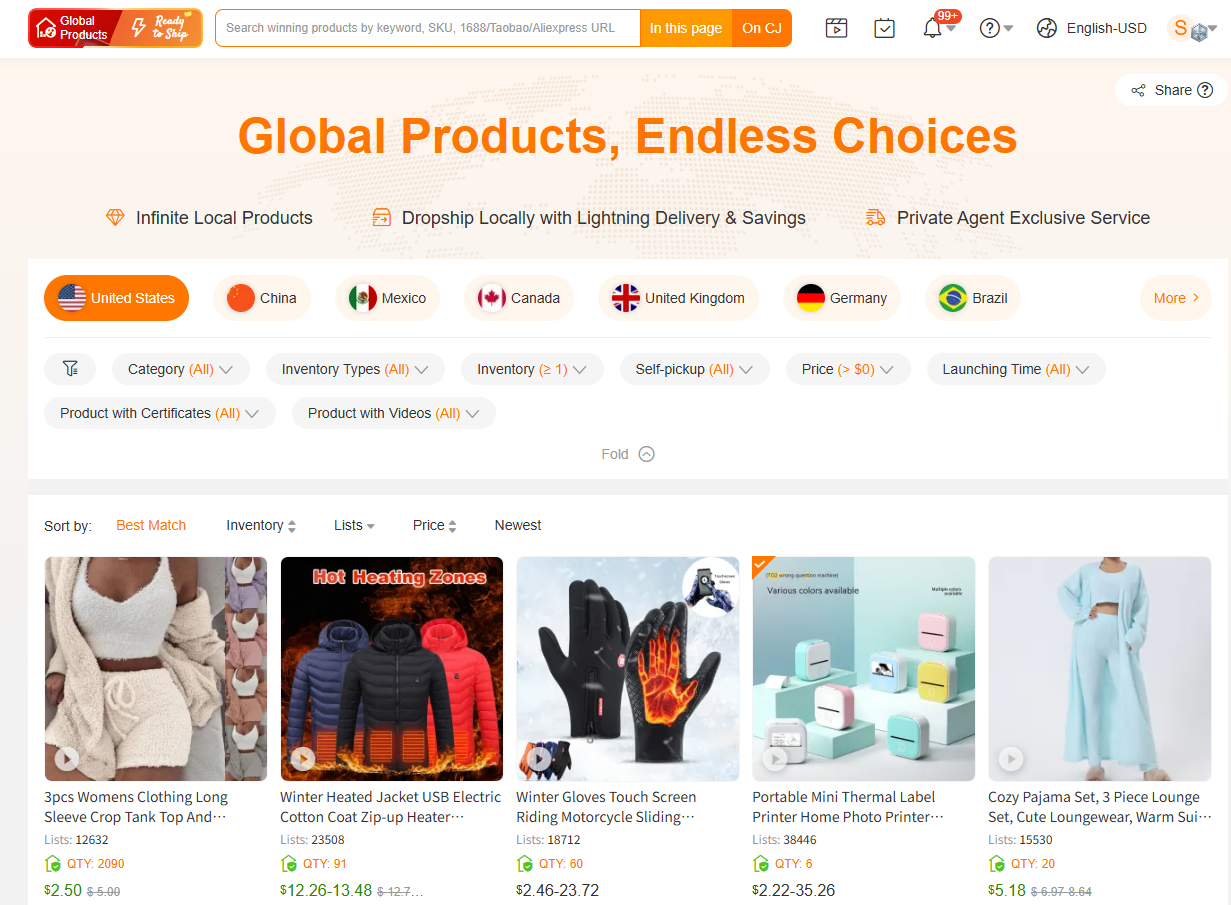
One useful feature for product researchers is the ability to request products that are not already available in CJ's catalog.
Imagine you see a product gaining traction through TikTok, competitor ads, AliExpress, Amazon, or another product discovery channel.
Finding the product is only the beginning.
You still need to answer questions such as:
-
Who supplies it?
-
What variants are available?
-
What is the actual product cost?
-
How much does it weigh?
-
Which shipping methods work?
-
Can it be branded?
-
Is the supplier capable of supporting larger order volume?
CJ's sourcing process is intended to connect that product-discovery stage with fulfillment.
According to CJ's current sourcing page, sellers can submit product links, images, and descriptions, and the platform can source through cooperating factories and major Chinese marketplaces.
That can be especially useful for a seller who has found a potential winning product but does not yet have direct factory relationships.
2. More Than One Shipping Option
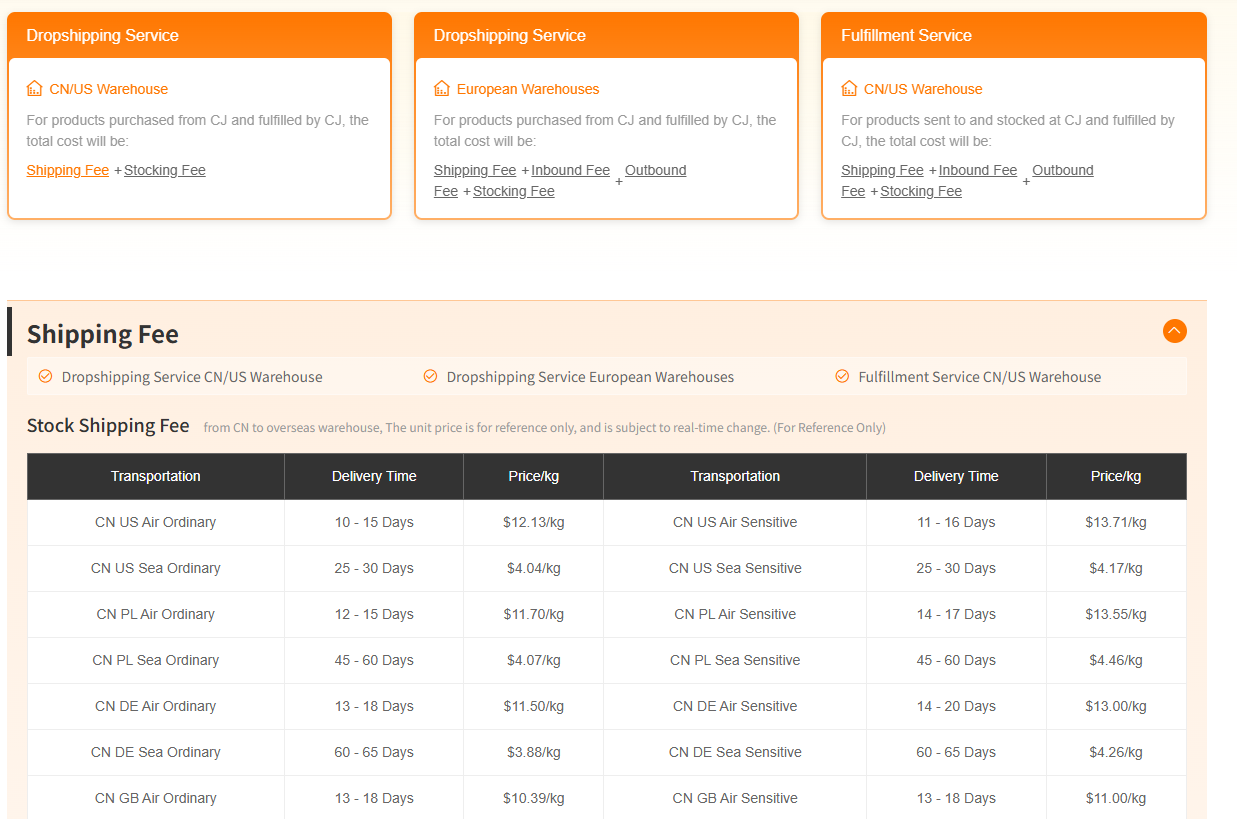
Shipping is one of the biggest factors affecting dropshipping profitability and customer satisfaction.
There is rarely one "best" shipping method for every order.
A lightweight product going to the United States may have different optimal logistics than a heavier item going to Germany, Australia, or Canada.
CJ provides multiple logistics options, while shipping costs and estimated delivery times depend on variables such as destination, product weight, attributes, and the selected shipping method. CJ provides a shipping calculator to compare available options.
This flexibility can be useful, but it creates an important responsibility for the seller:
Never assume that the logistics performance of one CJ product represents every CJ product.
Check the route before launching.
3. Warehousing and Inventory Options
Pure dropshipping normally means purchasing the product only after a customer orders.
That reduces inventory risk, but it can become less efficient once a product starts generating consistent sales.
For example, imagine a product suddenly reaches 50 orders per day.
Waiting for the supplier to prepare every order individually may introduce unnecessary uncertainty.
At that stage, keeping stock closer to the fulfillment operation can make more sense.
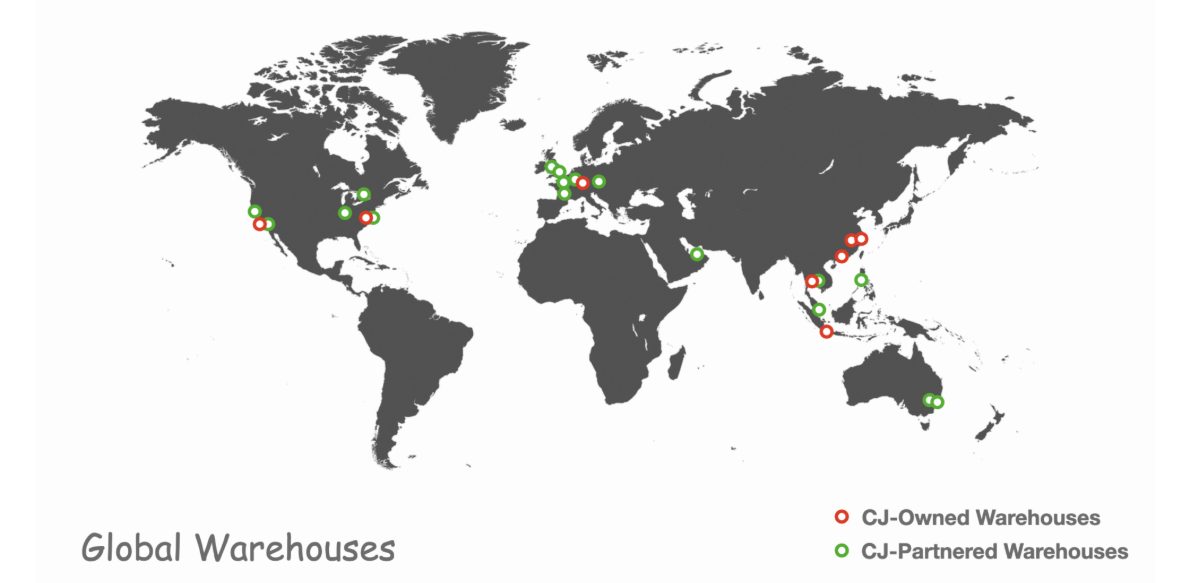
CJ provides fulfillment and inventory services through warehouses in multiple markets. Its service-fee documentation currently lists facilities or warehouse services covering China, the United States, Poland, Germany, and the United Kingdom, with fee structures depending on location and service type.
That creates a possible progression:
Test without heavy inventory → Find a winning product → Forecast sales → Prepare inventory → Improve fulfillment stability
This is a more mature approach than treating every order as an isolated dropshipping transaction forever.
4. Ecommerce Store Integration
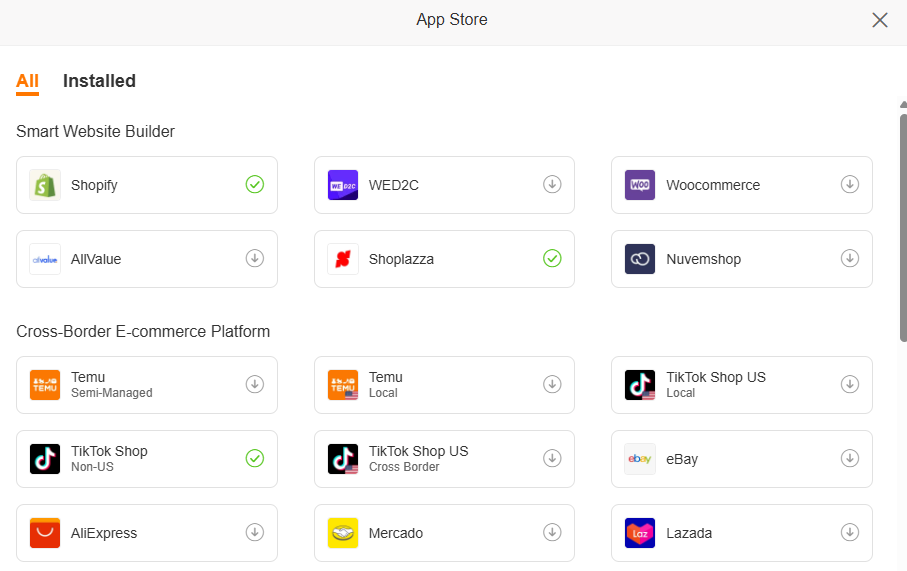
Manual fulfillment is manageable when you receive two orders per day.
It becomes a problem when you receive 200.
Manually copying customer addresses, selecting variants, ordering products, and uploading tracking numbers creates both labor costs and opportunities for mistakes.
Integration becomes increasingly valuable as order volume rises.
CJ's Shopify integration allows connected store orders to sync into its system for processing.
Automation does not remove the need to monitor orders, but it reduces repetitive operational work.
This distinction is important.
The goal of automation should not be to stop managing the supply chain. It should be to spend less time on repetitive tasks so that the seller can pay more attention to exceptions and decisions.
5. Dedicated Agent Support

A beginner usually asks:
"What product should I sell?"
A scaling seller asks different questions:
"Can you source this exact model?"
"Can the supplier improve the packaging?"
"How much inventory should I prepare?"
"Which shipping route is more stable?"
"Can we bundle these two products?"
"What happens if sales increase to 500 orders per day?"
Those questions require more than a product catalog.
Human support becomes more important as operations become more complex.
Public Shopify reviews frequently cite dedicated agents as one of the most helpful parts of CJdropshipping, particularly for sourcing, procedures, inventory, and problem solving.
The quality and speed of communication can still vary from case to case. That becomes important when we look at complaints later.
6. Branding and Custom Packaging
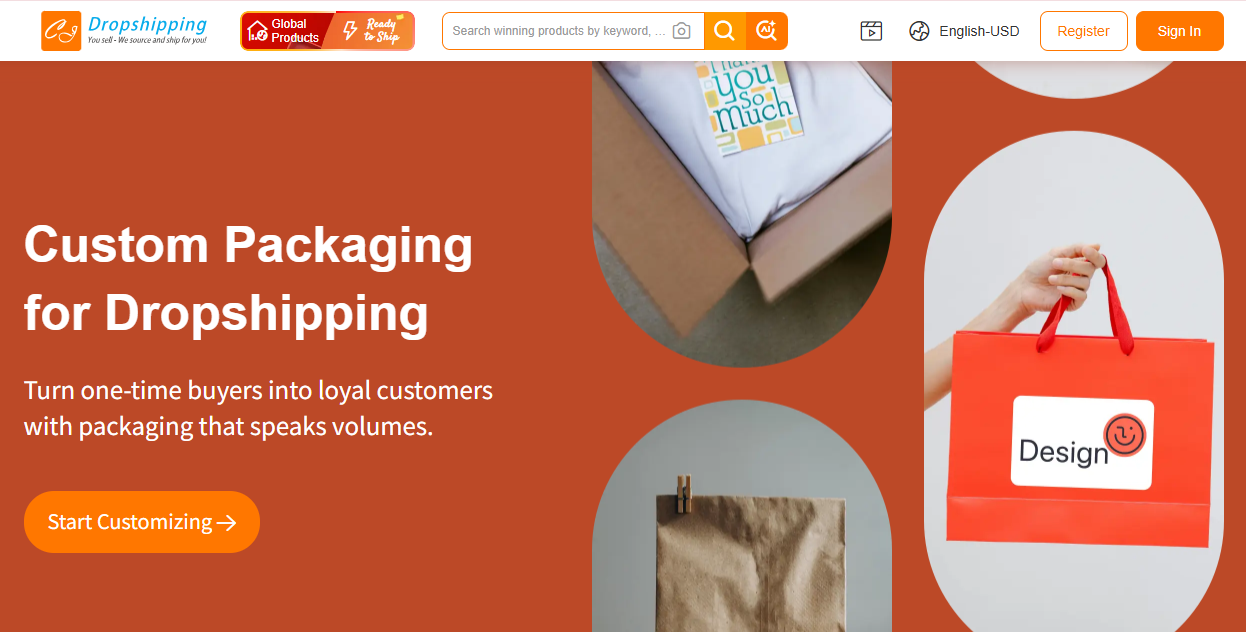
Dropshipping is often treated as a way to test products.
But successful stores eventually need to answer another question:
How do we stop looking like every other store selling the same item?
Branding becomes part of that transition.
CJ currently offers custom packaging options and allows sellers to connect packaging with products before fulfillment. Its custom packaging page says packaging options can start with low minimum quantities, depending on the packaging and requirements.
This does not transform a generic product into a strong brand automatically.
Brand development still requires positioning, product selection, customer service, content, design, and retention.
But branded packaging can be one part of that process.
Common CJdropshipping Complaints and What They Actually Mean
A trustworthy CJdropshipping review should not ignore complaints.
Every fulfillment business operating across suppliers, warehouses, international carriers, customs systems, and last-mile networks will experience exceptions.
The more important question is what those complaints reveal.
Recent low-rated reviews on Shopify and Trustpilot include reports involving delayed shipments, long processing, inventory discrepancies, incorrect fulfillment, communication problems, and pricing concerns. These are individual customer reports rather than proof that every seller will experience the same issue, but they identify areas that sellers should monitor carefully.
Let's examine the main complaint categories.
Complaint #1: "Shipping Took Longer Than Expected"
This is probably the most important complaint for any dropshipping supplier.
Shipping delays are especially painful because the end customer does not care which company caused the delay.
They bought from your store.
If a parcel is late, your brand receives the email, refund request, chargeback, or negative review.
One recent Shopify reviewer, for example, reported an international order that remained in transit for an extended period and expressed frustration with both the delay and the resolution process.
However, "CJ shipping time" is not one universal number.
Delivery can involve several separate stages:
Supplier availability → Processing → Warehouse handling → International transport → Customs → Local carrier → Final delivery
CJ's official shipping information distinguishes processing time from shipping time and currently states a general processing period of 3–5 days before the shipping stage. Actual logistics options and delivery estimates vary by method and destination.
That distinction matters.
If a shipping line says 7–12 days, it does not necessarily mean the customer receives the product 7 days after clicking "Buy."
How to Reduce Shipping Complaints
Before scaling a product:
-
Check the processing estimate.
-
Compare available shipping lines.
-
Check the destination country.
-
Confirm the warehouse location.
-
Place a test order.
-
Monitor real tracking performance.
-
Give customers realistic delivery expectations.
-
Prepare inventory when volume becomes predictable.
One of the biggest mistakes dropshippers make is advertising an aggressive delivery promise without testing the route themselves.
A better approach is to underpromise and deliver within a realistic window.
Complaint #2: "The Product Quality Was Not What I Expected"
Product quality is another common problem across dropshipping.
This is not unique to CJ.
A sourcing ecosystem can include many categories, factories, and production standards. Two products that look similar in photos can have very different materials, finishes, dimensions, durability, or packaging.
That is why product testing matters.
A seller should never spend thousands of dollars advertising a product that they have never physically inspected.
Before Scaling a Product
Order a sample and examine:
-
Materials
-
Color
-
Dimensions
-
Packaging
-
Instructions
-
Functionality
-
Durability
-
Customer experience
-
Shipping condition
-
Differences from your product page
If necessary, ask for additional photos or videos before purchasing inventory.
For products where size matters, such as apparel, dimensions and sizing information deserve even more attention.
A recent Trustpilot complaint involving fashion products, for example, criticized sizing accuracy as part of the customer's negative experience. That does not establish that all CJ fashion products have the same problem, but it illustrates why product-level testing is essential.
The supplier should perform quality control.
But the retailer also needs a product-validation process.
Complaint #3: "Inventory Changed or My Product Went Out of Stock"
A common misunderstanding about dropshipping is that an online listing equals permanent inventory.
It does not.
Products can sell out.
Factories can stop producing a variant.
Raw materials can change.
A viral product can suddenly receive thousands of orders.
Seasonal supply can tighten.
And marketplace inventory can move faster than systems update.
This becomes especially dangerous after a seller identifies a winning product.
Imagine your campaign generates 300 profitable orders per day and then the supplier suddenly runs out of your best-selling color.
The problem is no longer just sourcing.
It is inventory planning.
The Better Scaling Model
For early testing:
Low inventory commitment makes sense.
Once sales stabilize:
Forecast demand and prepare stock.
For larger campaigns:
Discuss private inventory or warehouse stocking before increasing advertising spend.
Public CJ reviews include positive references to agents helping merchants manage inventory, while some negative reviews report stock discrepancies or warehouse issues. Together, those experiences illustrate why inventory should be actively managed rather than assumed.
A serious ecommerce business should always know:
-
Current available inventory
-
Expected daily sales
-
Reorder point
-
Supplier lead time
-
Backup product options
-
Backup logistics options
Dropshipping reduces inventory risk.
It does not eliminate supply-chain risk.
Complaint #4: "Refunds and Disputes Took Too Long"
Refunds become more complicated when physical goods and logistics are involved.
Before deciding whether an order should be refunded, resent, returned, or investigated, the responsible team may need to examine:
-
Tracking history
-
Delivery status
-
Photos
-
Video evidence
-
Customer communication
-
Product condition
-
Logistics data
CJ's published Refund, Resend and Returns Policy asks sellers to open disputes through CJ and, depending on the case, provide evidence such as photos, videos, or screenshots of customer complaints. The policy also defines circumstances in which delayed orders, damaged products, or other fulfillment problems may qualify for a refund or resend.
This means sellers should build good documentation habits.
When something goes wrong, keep:
Order number + tracking + screenshots + photos/video + customer communication
The more complete your evidence is, the easier it becomes to investigate the problem.
More importantly, do not wait until the customer becomes angry before checking the order.
Exception monitoring should be part of daily operations.
Complaint #5: "Support Did Not Resolve My Problem Fast Enough"
Support is interesting because it appears on both sides of CJdropshipping reviews.
Many positive reviews specifically praise individual agents for fast assistance.
Some negative reviews complain about slow responses, repeated follow-ups, or unsatisfactory solutions.
Both can be true.
Simple questions are usually easier to solve than complicated logistics disputes involving a warehouse, supplier, carrier, or damaged inventory.
That does not mean poor communication should be ignored. If a fulfillment issue affects paying customers, sellers need useful updates.
But it also means merchants should communicate clearly.
Instead of:
"Where is my order?"
A better support message includes:
-
CJ order number
-
Tracking number
-
Customer country
-
Exact issue
-
Date the issue started
-
Screenshots
-
Requested resolution
For example:
Order CJXXXX has shown no tracking movement since September 12. The customer is requesting a refund. Please confirm the current parcel status and whether this order qualifies for resend or refund.
That gives support something concrete to investigate.
Complaint #6: "The Platform Feels Complicated"
This criticism is understandable.
A simple marketplace may have only a few actions:
Find product → Buy product → Ship product.
CJ includes more operational functions:
-
Product sourcing
-
Store authorization
-
Product connections
-
Order management
-
Shipping selection
-
Inventory
-
Warehousing
-
Custom packaging
-
Fulfillment
-
Disputes
The first experience can therefore feel more complicated than buying from one supplier.
But complexity and capability often increase together.
A seller processing five orders per month may not need all these tools.
A seller managing hundreds of orders across many SKUs may appreciate having them in one system.
The important question is not whether the platform has a learning curve.
It is whether learning the system eventually saves more operational work than it creates.
Complaint #7: "The Product or Shipping Price Changed"
Another misconception in ecommerce is that today's landed cost will remain unchanged forever.
It may not.
Product costs can change because of:
-
Supplier pricing
-
Material costs
-
Production volume
-
Variant changes
Shipping costs can change because of:
-
Parcel weight
-
Destination
-
Shipping method
-
Carrier pricing
-
Peak seasons
-
Remote-area fees
-
Logistics conditions
CJ's help documentation states that shipping cost depends on the method, destination country, weight, and product attributes.
That means your profitability calculation should not be:
Selling Price − Product Price = Profit
It should be closer to:
Selling Price − Product Cost − Shipping − Payment Fees − Advertising − Refunds − Apps − Taxes/Compliance Costs − Other Operating Costs = Real Profit
For example:
Selling price: $39.99
Product: $9.50
Shipping: $7.50
Payment/platform costs: $2
Advertising: $10
Expected refund/operating allowance: $2
Real contribution before other business costs:
$8.99
If shipping increases by $2, profit drops to $6.99.
That is a 22% decline in contribution margin even though your product's selling price never changed.
Small logistics changes matter.
CJdropshipping Customer Experience: Why Two Sellers Can Have Completely Different Results
One person may describe CJ as an excellent fulfillment partner.
Another may say they had a terrible experience.
This is not unusual in logistics.
Their businesses may be completely different.
Consider two stores.
Store A
-
One lightweight product
-
Stable supplier
-
US customers
-
Tested shipping route
-
Inventory prepared
-
Accurate product page
-
Good margins
Store B
-
30 random products
-
Multiple categories
-
No samples ordered
-
Customers across 15 countries
-
Cheapest shipping selected automatically
-
No inventory planning
-
Very aggressive delivery promises
Even if both use the same fulfillment platform, their customer experiences are unlikely to be the same.
Several variables have an outsized effect.
Product Selection
Stable products are easier to manage than highly viral products with unpredictable demand.
Destination Market
A route that performs well in one country may perform differently in another.
Shipping Method
The cheapest method is not always the best method.
Evaluate reliability, tracking, and customer expectations as well as cost.
Warehouse Location
A product already available near the target market can have a very different fulfillment profile from one that must travel internationally.
Inventory Strategy
On-demand purchasing can be excellent for testing.
Prepared inventory can be better for scaling.
Communication
Sellers who communicate forecasts, product requirements, quality concerns, and campaign plans give their supplier more opportunity to prepare.
Supply-chain management should become more deliberate as sales grow.
CJdropshipping Pros and Cons
A useful CJdropshipping review needs both.
Pros of CJdropshipping
Product sourcing
If the product you need is not already listed, you can submit a sourcing request.
Free entry
CJ's current user agreement states that account registration, browsing, product listing, and store-product connection do not require a general platform subscription fee. Sellers still pay for products, logistics, and applicable optional services.
Multiple logistics options
Shipping can be selected based on product and destination.
Ecommerce integrations
Connected stores can sync products and orders.
Dedicated support
Agent support is frequently mentioned positively in Shopify reviews.
Warehousing
Sellers can move beyond pure order-by-order purchasing and prepare inventory.
Custom packaging
Branding options can support sellers moving from simple product testing toward a branded ecommerce model.
Suitable for different growth stages
The same ecosystem can potentially support testing, sourcing, inventory preparation, and fulfillment.
Cons of CJdropshipping
Shipping is not equally fast for every route
International ecommerce still involves logistics uncertainty.
Product quality must be validated
Catalog photos cannot replace a sample.
Inventory can fluctuate
Especially with fast-growing products.
The platform has a learning curve
More features create more workflows to understand.
Complex disputes may require documentation and time
Refund and resend cases are not always instant.
Costs can change
Shipping and sourcing costs are affected by real supply-chain conditions.
Human support experiences can vary
Many customers praise dedicated agents, while some negative reviews report slow or unsatisfactory communication.
None of these disadvantages automatically means CJ is unsuitable.
They mean sellers should evaluate it as an operating partner rather than a magic solution.
CJdropshipping vs AliExpress: Which Is Better?
The two models overlap, but they are not identical.
AliExpress is fundamentally a large consumer and cross-border marketplace connecting buyers with many individual sellers.
CJdropshipping is designed more specifically around ecommerce sourcing and fulfillment workflows.
| Feature | CJdropshipping | AliExpress-Based Sourcing |
|---|---|---|
| Large product selection | Yes | Yes |
| Product sourcing request | Yes | Depends on supplier |
| Dedicated agent support | Available | Usually supplier-based |
| Centralized order fulfillment | Yes | Often split across sellers |
| Store integration | Yes | Usually requires an app/tool |
| Inventory preparation | Available | Supplier dependent |
| Custom packaging | Available | Supplier dependent |
| Overseas warehousing | Available | Varies by seller |
| Good for product discovery | Yes | Yes |
| Good for supply-chain scaling | Stronger focus | Depends heavily on supplier |
AliExpress can be useful during product discovery and early research.
CJ becomes more interesting when a seller wants to centralize sourcing, fulfillment, logistics, and later-stage supply-chain functions.
That does not mean every CJ product beats every AliExpress supplier.
Individual quotations still need to be compared.
CJdropshipping vs a Private Supplier
Another common question is whether successful sellers should eventually leave platforms and work with a private supplier.
There is no universal answer.
Think about business stages instead.
Stage 1: Product Testing
Your main goal is learning whether customers want the product.
You want:
-
Low commitment
-
Flexible product selection
-
No huge inventory investment
CJ can work well in this stage.
Stage 2: Consistent Sales
Now your priorities change.
You need:
-
More reliable sourcing
-
Better communication
-
Inventory visibility
-
Stable shipping
-
Better cost control
A dedicated agent and prepared inventory become more valuable.
Stage 3: Brand Development
Now you may need:
-
Custom packaging
-
Logo printing
-
Product bundles
-
Private labeling
-
Dedicated inventory
CJ offers several of these functions, including custom packaging.
Stage 4: Large-Scale Supply Chain
At sufficiently high volume, businesses may negotiate more customized production, warehousing, and logistics arrangements.
At that point, the correct decision depends on:
-
Order volume
-
Product complexity
-
Manufacturing requirements
-
Geographic markets
-
Cost
-
Quality requirements
-
Existing operational team
CJ may remain part of the supply chain, or the business may adopt additional suppliers and 3PL partners.
The point is not to stay loyal to one fulfillment model forever.
The goal is to choose the model appropriate for your current business stage.
Who Should Use CJdropshipping?
CJdropshipping is particularly worth considering if you:
-
Are starting a dropshipping business
-
Want to test products without buying large quantities
-
Need help sourcing products
-
Sell into multiple international markets
-
Want store-order synchronization
-
Need multiple shipping options
-
Want agent assistance
-
Expect to prepare inventory after validating a product
-
Want custom packaging or branding options
-
Prefer managing several supply-chain functions in one ecosystem
CJ may also be valuable for sellers who have outgrown the "order everything manually from marketplace suppliers" stage but are not yet ready to build an independent international supply-chain team.
Who Might Not Be a Good Fit?
CJdropshipping will not be ideal for every business.
You may need a different solution if:
-
Every SKU must have guaranteed next-day delivery
-
You manufacture highly specialized products
-
Your business requires direct control of a dedicated factory
-
You operate your own established warehouse network
-
You require extremely specific enterprise SLAs
-
You are unwilling to test products or monitor logistics
-
You expect every product to be permanently available in every warehouse
Depending on the business, a local wholesaler, dedicated manufacturer, specialized sourcing company, or independent 3PL may be a better fit.
Choosing another solution does not mean CJ is bad.
It means supply-chain requirements differ.
How to Get a Better Experience With CJdropshipping
Whether CJdropshipping is worth it depends partly on how you use it.
Here is a practical checklist.
1. Order Samples
Do this before significant ad spend.
Verify what the customer will actually receive.
2. Test Your Shipping Route
Ship a sample to your main destination market.
Measure actual processing and delivery time.
3. Check the Entire Landed Cost
Do not evaluate only the product price.
Include shipping and operating costs.
4. Verify Inventory Before Scaling
A viral ad campaign can create a supply-chain problem overnight.
Confirm whether stock can support the expected volume.
5. Talk to Your Agent Before Large Campaigns
If you expect a significant sales spike, communicate it.
Forecasting gives the supply side more time to prepare.
6. Prepare Inventory for Proven Products
Dropshipping is useful for validating demand.
It does not mean you must avoid inventory forever.
For a proven product, strategic inventory can improve stability.
7. Use Realistic Delivery Promises
Do not advertise five-day delivery because the fastest theoretical logistics estimate says five days.
Account for processing and real-world variability.
8. Monitor Orders Proactively
Pay attention to orders with:
-
No tracking update
-
Abnormal tracking
-
Long processing
-
Failed delivery
-
Incorrect address
-
Customer complaints
Solve exceptions before they turn into chargebacks.
9. Document Problems Properly
For a dispute, save:
-
Photos
-
Videos
-
Tracking
-
Screenshots
-
Customer emails
-
Order details
CJ's dispute policy explicitly calls for supporting evidence in several claim types.
10. Maintain a Backup Plan
For important winning products, know what you would do if:
-
Supplier inventory runs out
-
Shipping route becomes unavailable
-
Cost increases
-
Product quality changes
Strong ecommerce businesses do not depend on everything going perfectly.
They prepare for exceptions.
Is CJdropshipping Reliable for Scaling?
CJdropshipping can support businesses beyond the beginner stage, but the way sellers use the platform should change as volume increases.
A beginner may operate like this:
Find product → List product → Receive order → Fulfill
A more mature seller should move toward:
Test → Validate → Forecast → Source → Prepare inventory → Improve packaging → Optimize logistics → Monitor fulfillment
That change is significant.
At ten orders per month, one late package is an inconvenience.
At 10,000 orders per month, a 2% fulfillment issue means 200 affected customers.
Scaling therefore requires better processes, not simply more orders.
CJ's warehousing, sourcing, packaging, and agent system can support that transition, but sellers still need to manage the business strategically.
No fulfillment partner can make poor inventory planning, unrealistic customer promises, weak product validation, or unprofitable advertising disappear.
Is CJdropshipping Free?
CJdropshipping is generally free to register and begin using, but "free" should not be misunderstood as "fulfillment has no cost."
CJ's current user agreement states that registration, browsing, listing products, and linking store products do not carry a general usage charge. However, sellers still pay applicable costs when using products and services, including product costs, logistics, customized packaging, private inventory, photography, and other specific services.
This is a sensible distinction:
Platform access can be free. Running an ecommerce supply chain is not.
Always calculate your real landed cost before selling.
How Should You Interpret Online CJdropshipping Reviews?
Reviews are useful, but they should be read carefully.
At the time of this article, Shopify shows CJdropshipping with a 4.9 rating across more than 2,800 reviews and a large majority of five-star feedback. Trustpilot also shows a high proportion of positive ratings.
That is meaningful evidence that many merchants report positive experiences.
But it does not prove every order will go well.
Similarly, one negative review does not prove every seller will experience the same issue.
The best way to use public reviews is to look for patterns.
Positive patterns include:
-
Agent support
-
Product sourcing help
-
Store setup assistance
-
Inventory guidance
-
Easier fulfillment workflows
Negative patterns include:
-
Shipping delays
-
Processing delays
-
Inventory discrepancies
-
Communication frustrations
-
Product issues
-
Cost changes
Those patterns tell sellers where to pay attention.
The goal of reading reviews should not be to find proof for a decision you have already made.
It should be to identify risk before your customers discover it for you.
Final Verdict: Is CJdropshipping Worth It?
So, is CJdropshipping worth it?
For sellers who want more than a basic product marketplace, CJdropshipping is worth considering.
Its biggest advantage is not one individual product or one shipping line.
It is the ability to combine:
Product sourcing
Order fulfillment
Logistics
Warehousing
Inventory
Store integrations
Custom packaging
Agent support
within one ecommerce supply-chain ecosystem.
That can make CJ particularly useful for sellers moving through the progression from product testing to stable fulfillment and eventually branding.
However, CJdropshipping should not be treated as a system that removes every risk from ecommerce.
You still need to:
-
Test products
-
Order samples
-
Check shipping routes
-
Understand processing times
-
Monitor inventory
-
Calculate real margins
-
Communicate with your agent
-
Track fulfillment exceptions
-
Prepare inventory before scaling
-
Set realistic expectations for customers
There will be products that work well with CJ and products where another supplier may be better.
There will be shipping routes that perform well and others that require adjustment.
There will be smooth orders and exceptions that need investigation.
That is normal supply-chain reality.
For beginners, CJ can reduce the barriers to sourcing and fulfillment.
For growing stores, its value can shift toward agents, inventory, warehousing, and logistics coordination.
For established brands, the decision becomes more specific and should be based on cost, customization, geography, volume, and operational requirements.
The most accurate conclusion is therefore not that CJdropshipping is perfect.
It is this:
CJdropshipping works best when you treat it as a supply-chain partner, not as a substitute for supply-chain management.
When sellers understand that distinction and actively manage products, inventory, costs, and logistics, CJdropshipping can be a valuable platform for both testing and scaling an ecommerce business.